
305: Why? Television!
The Screen That Taught Us How to Be Stupid

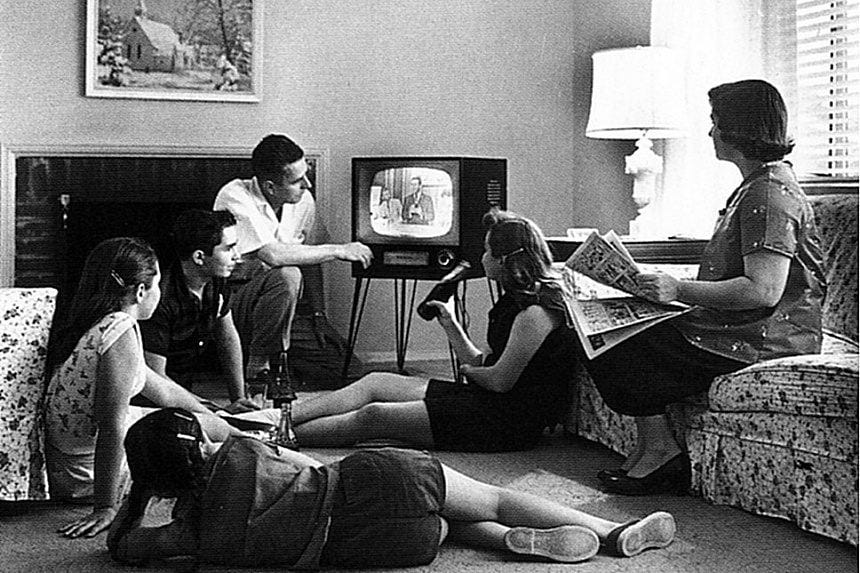
The panic over social media has always had a strangely comforting quality. It gives the crisis a location. It lets us point at X, or Facebook, or TikTok, or LinkedIn, and say: there. That is where the madness lives.
Spend enough time on X and the diagnosis seems obvious. The platform has become a carnival of grievance, performance, amateur intelligence, weaponized screenshots, and political fantasy. Its users do not merely argue. They sort one another into enemies, cowards, traitors, bots, marks, and prophets. It is a machine for turning uncertainty into posture.
LinkedIn offers a more disturbing variation because it wraps the same unreality in the language of professionalism. X rages. LinkedIn smiles. X shouts conspiracy in the street. LinkedIn writes it as a leadership lesson, adds a photograph of someone looking meaningfully out a window, and turns the collapse of judgment into a framework for growth.
Meta’s platforms are different again. Facebook and Instagram have less of the open combat of X and less of the managerial theatre of LinkedIn. Their atmosphere is closer to shared hallucination. Families, neighbourhoods, churches, wellness circles, political communities, lifestyle brands, and nostalgic fragments of the past drift together until speculation begins to feel like memory. Disinformation on these platforms often becomes something warmer and more dangerous than a lie. It becomes belonging.
Yet all of this may still be downstream.
The deeper problem may remain the older screen. The one mounted on the wall. The one we stopped blaming because it became furniture. The one that shaped the modern nervous system before the internet arrived to accelerate its habits.
Television remains the primary source of stupidity in our collective intelligence.
That claim sounds strange because television appears to be declining.
Similarly trust has also collapsed. Gallup reported in 2025 that trust in U.S. mass media had fallen to 28 percent, a record low in its long-running measure. Older adults remain more trusting of mass media than younger groups, but the general direction is unmistakable: the institution that once claimed to organize public reality now operates under conditions of deep suspicion.
This is the easy story: television lost, social media won, and the public sphere shattered.
The harder story is that social media did not replace television so much as inherit its training. The platforms did not invent collective stupidity. They automated it. They personalized it. They made it participatory. They gave every viewer a control room, a comment box, and a tiny broadcast tower.
Television trained the public to mistake witnessing for knowing.
It taught us that reality is something that appears before us already edited. It arrives with theme music, lighting, framing, repetition, hosts, experts, villains, victims, and commercial breaks. It gave us the feeling of being informed while keeping us physically still, politically distant, and emotionally available for whatever sequence came next.
The great power of television was never simply propaganda. Propaganda implies a message imposed from above. Television did something more intimate. It organized attention into ritual. The evening news. The breaking alert. The panel debate. The courtroom spectacle. The disaster montage. The election map. The celebrity confession. The war footage. The commercial promise of relief.
A society does not need to be deceived into stupidity when it has been trained to consume the world as spectacle.
This is where the question of collective intelligence becomes unavoidable.
A healthy collective intelligence does not require everyone to be brilliant. It requires feedback. It requires memory. It requires friction between perception and consequence. It requires institutions that can say, slowly and publicly, what is known, what is unknown, who benefits, who pays, and what follows.
Television weakened those muscles.
It converted public life into a sequence of consumable scenes. It rewarded speed over understanding, confidence over humility, conflict over relation, and personality over structure. It made politics feel like weather: something to watch, complain about, predict, and endure. It made war feel like graphics. It made economics feel like numbers moving on a screen. It made climate catastrophe feel like footage from somewhere else.
The stupidity produced by television is therefore not the absence of intelligence. It is intelligence deprived of agency.
People know many things. They perceive hypocrisy. They sense corruption. They understand, often with painful clarity, that institutions do not serve them equally. What television teaches is that this knowledge has nowhere to go. It can be felt. It can be shouted at. It can be folded into identity. It can be monetized by the next segment. But it cannot easily be acted upon.
Social media enters that wound.
X offers agency as combat. LinkedIn offers agency as personal optimization. Facebook offers agency as communal belief. Instagram offers agency as aesthetic coherence. TikTok offers agency as memetic fluency. YouTube offers agency as endless apprenticeship under charismatic interpreters.
Each platform provides a different answer to the same deprivation.
You are not powerless, says X. You can denounce.
You are not powerless, says LinkedIn. You can brand.
You are not powerless, says Facebook. You can belong.
You are not powerless, says Instagram. You can appear.
You are not powerless, says TikTok. You can remix.
You are not powerless, says YouTube. You can go deeper forever.
These are not false promises. They are partial powers. People do learn, organize, discover, and resist through these systems. The danger is that each platform also preserves the television logic beneath its interface. The world still arrives as content. The self still becomes audience. The crisis still becomes feed.
The stupidity of our collective intelligence is not located in the individual user. It is located in the architecture of attention that separates perception from participation.
This is why Meta’s shared hallucination feels so potent. Faith is not merely belief without evidence. Faith is belief embedded in relation. It is what happens when a claim becomes part of a community’s emotional infrastructure. Once a story helps people belong to one another, correcting the story threatens the bond. The fact-checker then appears as an intruder. Evidence becomes aggression. Doubt becomes betrayal.
Television prepared this terrain by making shared reality feel passive. Millions could watch the same broadcast and feel together while doing nothing together. The platforms intensified the feeling by allowing everyone to perform participation without requiring the burdens of collective responsibility.
This is also why LinkedIn can feel worse than X.
X is visibly broken. Its derangement announces itself. LinkedIn is stupidity with institutional confidence. It is where managerial ideology launders crisis into inspiration. Layoffs become resilience. Burnout becomes discipline. Automation becomes opportunity. Surveillance becomes productivity. Collapse becomes a lesson in mindset.
Where X produces paranoia, LinkedIn produces obedience with good lighting.
The deeper pattern is the same: systems that should help us think together instead teach us how to narrate our adaptation to power.
Television did this first at civilizational scale. It normalized the idea that authority speaks from the screen and the public responds emotionally. It taught generations to recognize power by production value. The anchor desk, the studio, the camera angle, the confident voice, the urgent chyron, the expert panel: these became the aesthetics of knowing.
Even rebellion learned to imitate the format.
The podcaster at the desk, the streamer with the overlay, the influencer with the ring light, the analyst with the map, the citizen journalist with the live feed: each can challenge the old broadcasters while reproducing the grammar of broadcast authority. The face addresses the many. The many react. The system continues.
This is the cruel continuity of media history. New tools often overthrow old gatekeepers while preserving old habits of perception.
The result is a public that is simultaneously over-informed and under-organized, suspicious and suggestible, expressive and isolated, cynical and credulous. People can identify manipulation everywhere except in the form of attention itself. They can distrust every institution while remaining obedient to the rhythms those institutions established.
The source of stupidity is not ignorance. It is a damaged relationship between knowing and doing.
A public becomes stupid when it can see suffering but cannot metabolize it into care.
A public becomes stupid when it can name corruption but cannot build counterpower.
A public becomes stupid when every crisis becomes a scene, every scene becomes a take, every take becomes identity, and every identity becomes a market.
This is why the remedy cannot be media literacy alone. Media literacy is necessary, but often too small. Teaching people to spot falsehoods does not address the deeper training that makes reality feel like something consumed at a distance. A person can recognize misinformation and still remain trapped in spectacle. A person can distrust television and still think televisually.
The more difficult task is rebuilding collective intelligence as a lived practice.
That means restoring the connection between attention and obligation. It means treating knowledge as something produced through relation, not merely received through screens. It means rebuilding spaces where people can deliberate, repair, test, remember, and act together. It means creating institutions that are slower than the feed and more accountable than the broadcast. It means recovering forms of authority that emerge from competence, service, reciprocity, and consequence.
The question is not whether X is worse than LinkedIn, or Facebook worse than television, or TikTok worse than cable news. Each system reveals a different injury.
X reveals what happens when public speech is organized as combat.
LinkedIn reveals what happens when professional life becomes compulsory self-propaganda.
Meta reveals what happens when belonging becomes a hallucination engine.
Television reveals the older wound: a society trained to watch power rather than practice it.
The old screen still matters because its deepest lesson survived its decline. It taught us that the world happens elsewhere, that authority appears as performance, that politics is something to follow, that catastrophe is something to watch, that intelligence means having the right interpretation before the next segment begins.
The platforms took that lesson and made it intimate. They placed the broadcast inside the pocket, the bedroom, the workplace, the family, the nervous system. They turned the audience into unpaid programmers of its own enclosure.
The future of authority will be shaped by whether this pattern can be broken.
A society that watches everything will understand less and less of what it sees. A society that reacts to everything will lose the ability to respond. A society that confuses expression with participation will become louder as its agency disappears.
The source of stupidity in our collective intelligence is the severing of knowledge from consequence.
Television made that severing feel normal.
The platforms made it feel like freedom.
What comes next depends on whether we can build forms of shared attention that return us to the world rather than merely showing it to us.

 Tiktok failed to load.
Enable 3rd party cookies or use another browser
Maybe channeling Guy Debord. I too enjoyed this piece. Especially the characterization of Link'd In. 😆
Channeling some Dietrich Bonhoeffer? 😆 Enjoyed the piece, Thanks.