
267: Before the Anschluss
The Politics of Inevitability Then and Now

Shout out to Comrade David Graham for inspiring this issue via the apt historical metaphor…
Nothing is being taken from you. That’s the reassurance—and that’s the danger.
There is no emergency announcement, no visible rupture, no single decision you can point to and say that was it. Daily life continues. Institutions still operate. Borders still exist. Power insists that what you are feeling is anxiety, not analysis—and most people accept that framing because anxiety can be dismissed, while analysis demands action.
This is how absorption begins in modern societies: not with force, but with reassurance. Not with invasion, but with inevitability. Not with orders, but with a quiet narrowing of what feels sensible to say out loud.
History has seen this before.
Austria did not lose its sovereignty in March 1938. By the time the Anschluss occurred, Austria had already been psychologically annexed. The crossing of the border was merely the moment when the internal story became external fact.
Before the Anschluss, Austria still looked like itself.
Elections existed. Courts functioned. Newspapers printed. Political arguments continued in public spaces. Nothing about daily life screamed emergency. That normality became the proof people used to reassure themselves that the warnings were exaggerated.
But beneath that surface, the space of possibility was shrinking. Political imagination was being disciplined. Certain positions were recoded as irresponsible. Certain concerns were framed as dangerous to stability. Independence itself began to sound impractical—an emotional attachment rather than a serious option.
Austria was not convinced to abandon sovereignty. It was convinced that sovereignty was no longer realistic.
This is the politics of inevitability: when power does not need your agreement, only your resignation.
Austrian leaders believed restraint would preserve peace. Each concession was justified as pragmatic, temporary, necessary to avoid something worse. But accommodation does not calm an expansionary power. It educates it.
Every compromise demonstrated that pressure worked. Every effort to avoid conflict shifted the burden of restraint onto the weaker party. Over time, the pattern became internalized. Austria began anticipating demands and adjusting in advance.
Once a society starts doing that, coercion becomes optional. Power no longer needs to threaten. Everyone already knows the limits.
When the decisive moment arrived, it arrived dressed as legality.
There were procedures, votes, decrees, and signatures. Familiar forms remained intact even as their substance vanished. The plebiscite did not discover public will; it staged it. Legitimacy became a performance designed to make the outcome feel settled and irreversible.
This is a recurring misunderstanding about authoritarian expansion. Law is not destroyed first. It is hollowed out, then repurposed as theatre.
By the late 1930s, many Austrians were not ideologically committed. They were exhausted.
Economic strain. Political instability. Endless crisis. The promise of order felt like relief. Stability was framed as compassion. Resistance was framed as cruelty, because it risked reopening conflict.
When people are tired enough, they stop asking what kind of order is being offered. They ask only whether it will last.
Spectacle locks in the story
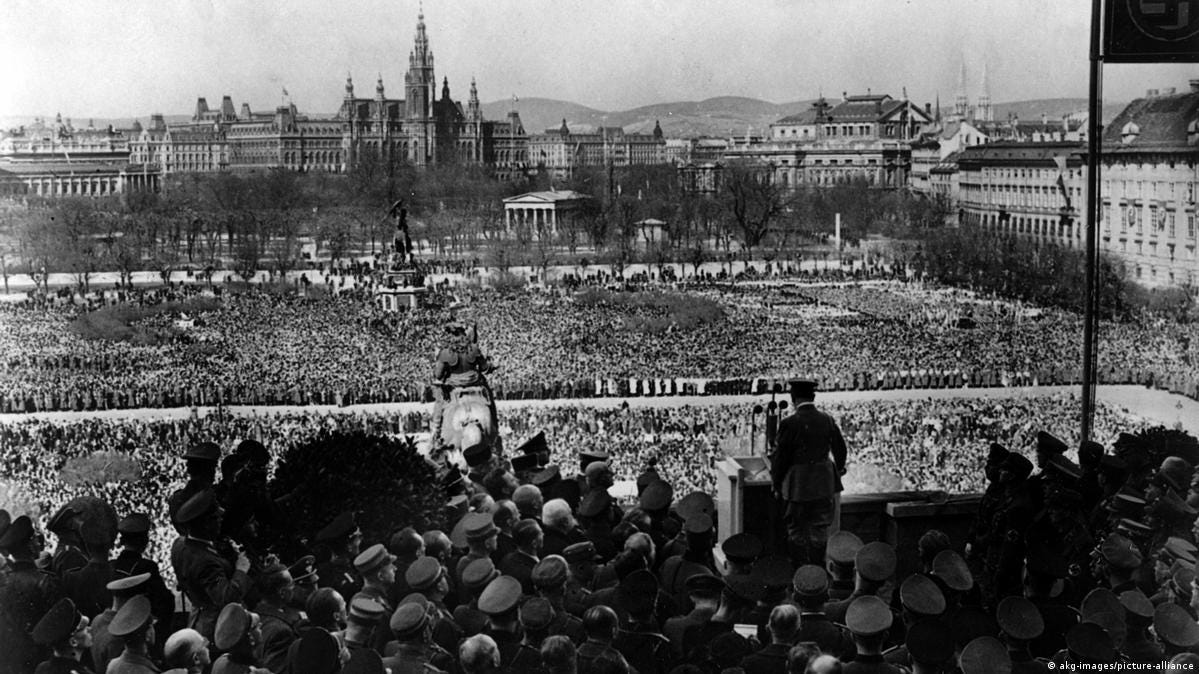
The crowds, the flags, the cheers—history often treats these images as evidence of popular support. That misses their function.
Spectacle is not proof. It is enforcement.
Once unanimity is publicly performed, dissent becomes deviant by definition. Silence becomes suspicious. Opposition is reframed as disruption. At that point, resistance no longer looks like defense of sovereignty. It looks like refusal to move on.
The most powerful outcome was psychological: people were taught to reinterpret what had happened as something they had chosen.
Up to this point, it is possible to read this as a warning about another country, another time.
That comfort is part of the problem.
Because the relevance of Austria is not ideological. It is procedural. It shows how sovereignty is lost without drama, how domination advances without declaring itself, how societies are trained to accept constraints as facts of life rather than political outcomes.
This pattern does not require tanks. It works just as well through media saturation, economic integration, elite pre-compliance, and the slow cultural shift where resistance starts to feel embarrassing.
Canada today is saturated by external narratives, external economic gravity, external political theatre. Policy options are quietly narrowed based on what will be tolerated elsewhere. Elites align early to remain relevant. Public discourse is policed less by law than by social sanction—by the fear of being labeled unrealistic, extreme, or unserious.
The most common argument is that this is simply how the world works now. Interdependence. Pragmatism. Maturity.
That argument is indistinguishable from inevitability.
Austria’s greatest mistake was not cowardice. It was believing there would be a clearer moment later.
People assumed that if things truly became unacceptable, resistance would become obvious and justified. Instead, the threshold kept moving. By the time recognition arrived, every remaining option felt radical.
That is the trap of inevitability. It does not remove choice. It delays it until choice looks unreasonable.
Before the Anschluss is the phase where nothing feels urgent. Where warnings are dismissed as alarmism. Where the dominant instinct is to stay calm, stay respectable, and trust that things will not go too far.
History’s lesson is not that catastrophe announces itself. It’s that absorption feels like continuity—until it doesn’t.
And by the time everyone agrees something irreversible has occurred, the irreversible part is already over.

 Tiktok failed to load.
Enable 3rd party cookies or use another browser
I know you’re unlikely to see this, but this is the best thing you’ve ever written. Thank you.
BTW: Good choice for video at the end. Blind partisanship, and an unwillingness to speak truth to power if it is associated with specific corporate brands, is part of how ideological takeovers (whether foreign or "domestic" brands) become so much easier.